
Subfamily FORMICINAE Author: Joe A. MacGown |
||
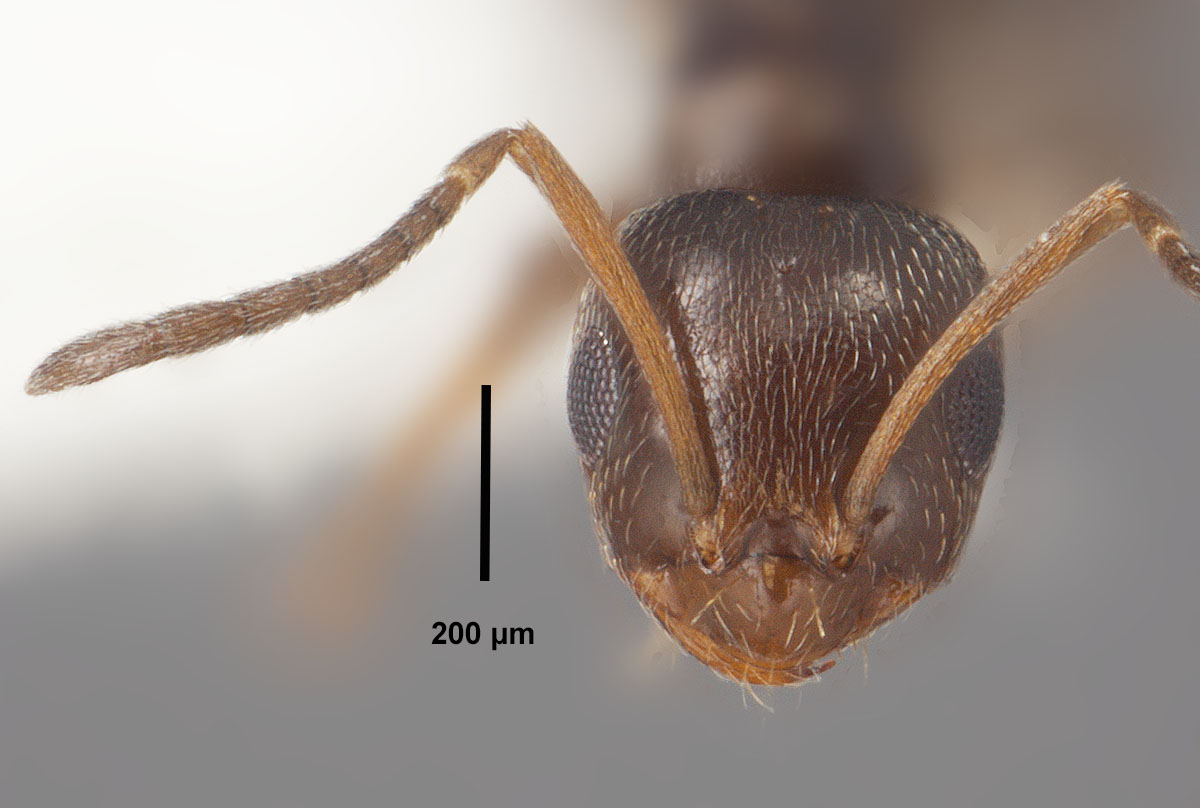 Brachymyrmex patagonicus, full face view of the head of a worker (Photo by James Lewis and Joe A. MacGown) |
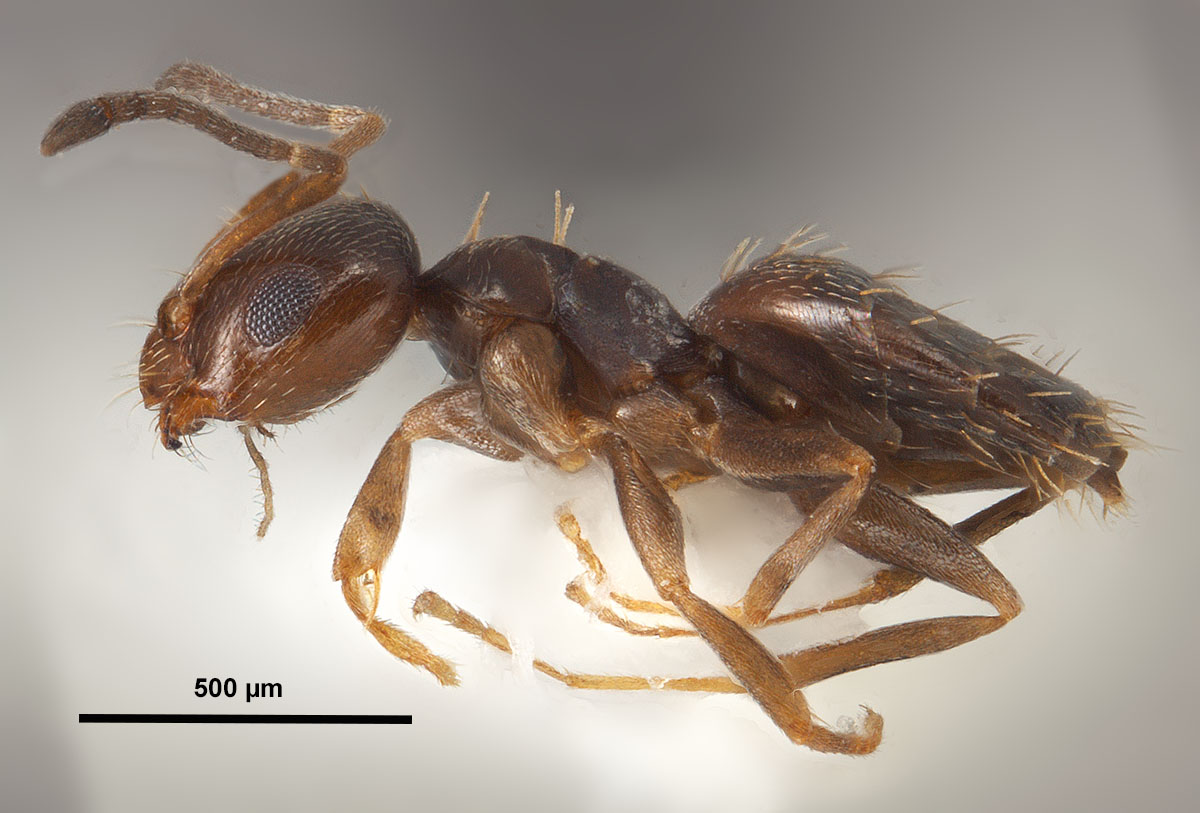 Brachymyrmex patagonicus, lateral view of of a worker (Photo by James Lewis and Joe A. MacGown) |
 Brachymyrmex patagonicus, dorsal view of of a worker (Photo by James Lewis and Joe A. MacGown) |
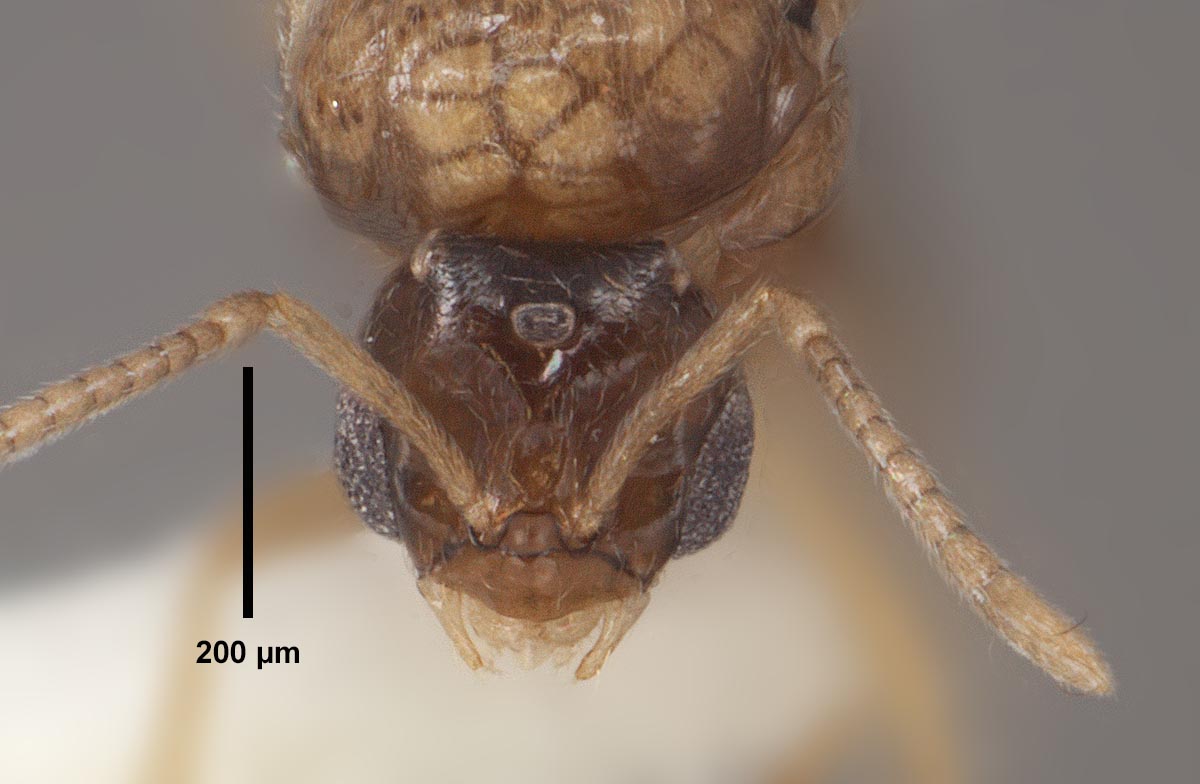 Brachymyrmex patagonicus, full face view of a male (Photo by James Lewis and Joe A. MacGown) |
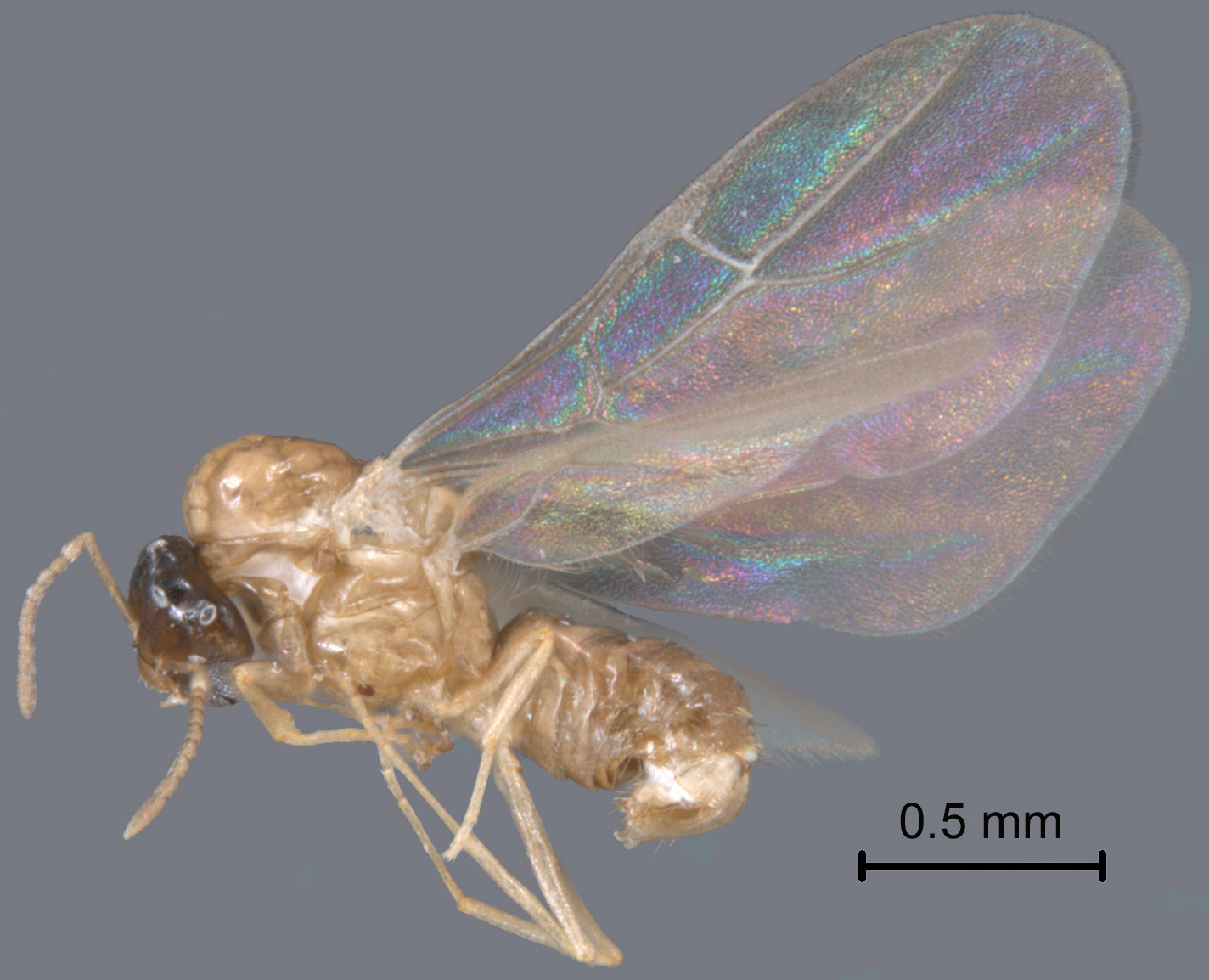 Brachymyrmex patagonicus, lateral view of a male (Photo by Joe A. MacGown) |
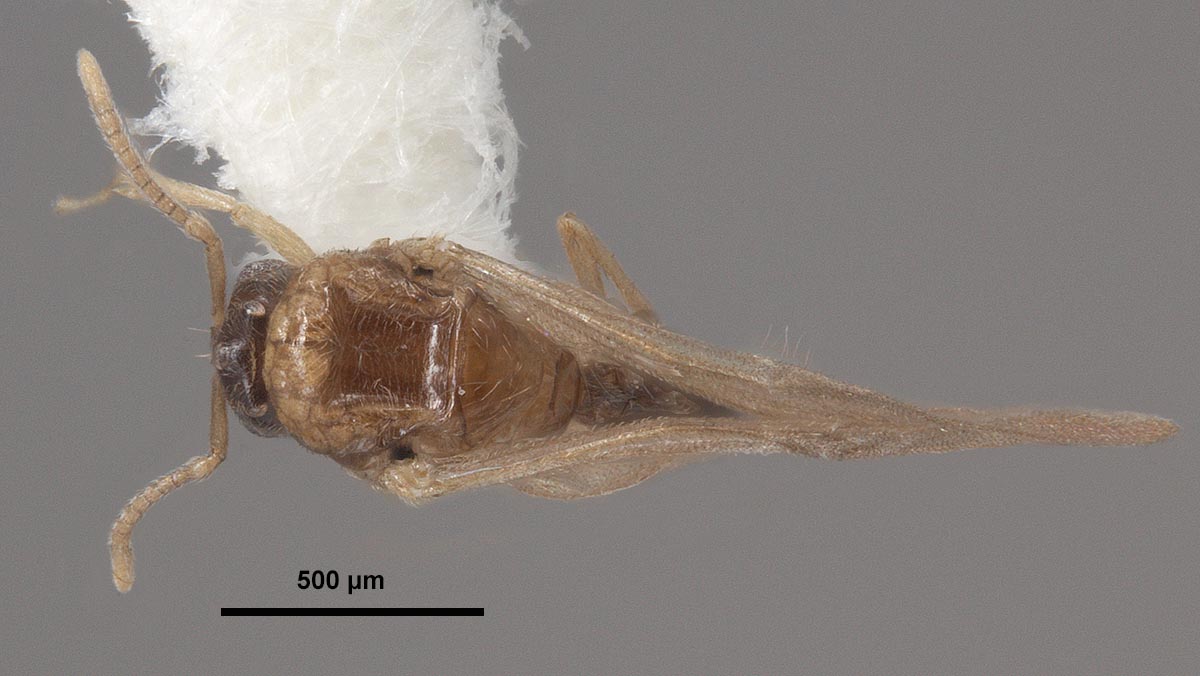 Brachymyrmex patagonicus, dorsal view of a male (Photo by James Lewis and Joe A. MacGown) |
|
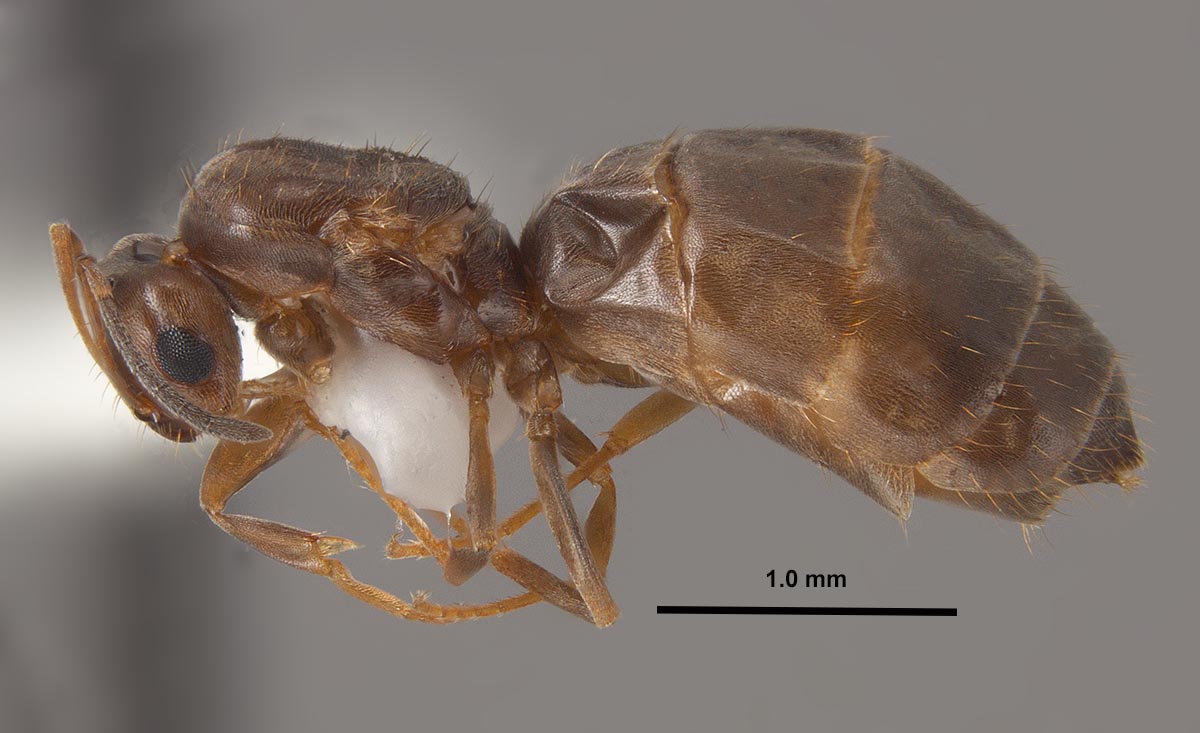 Brachymyrmex patagonicus, lateral view of a queen (Photo by James Lewis and Joe A. MacGown) |
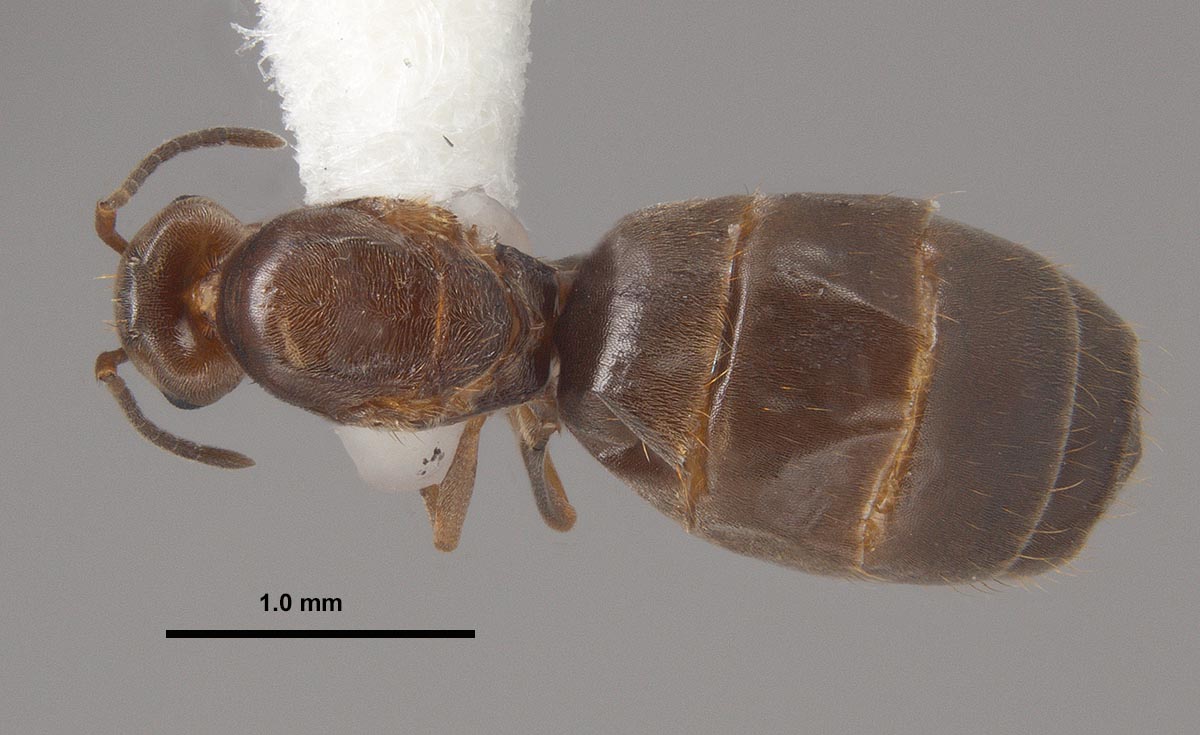 Brachymyrmex patagonicus, dorsal view of a female (Photo by James Lewis and Joe A. MacGown) |
|
||
|
||
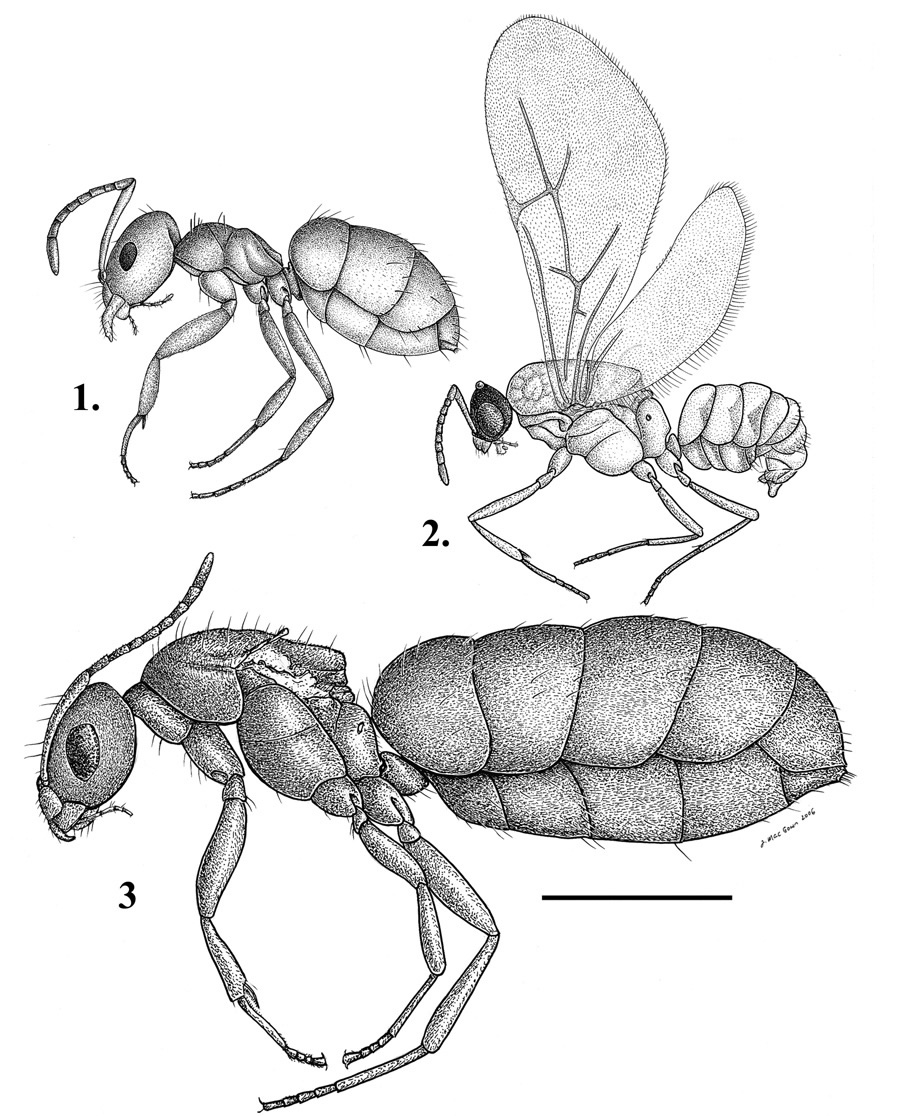
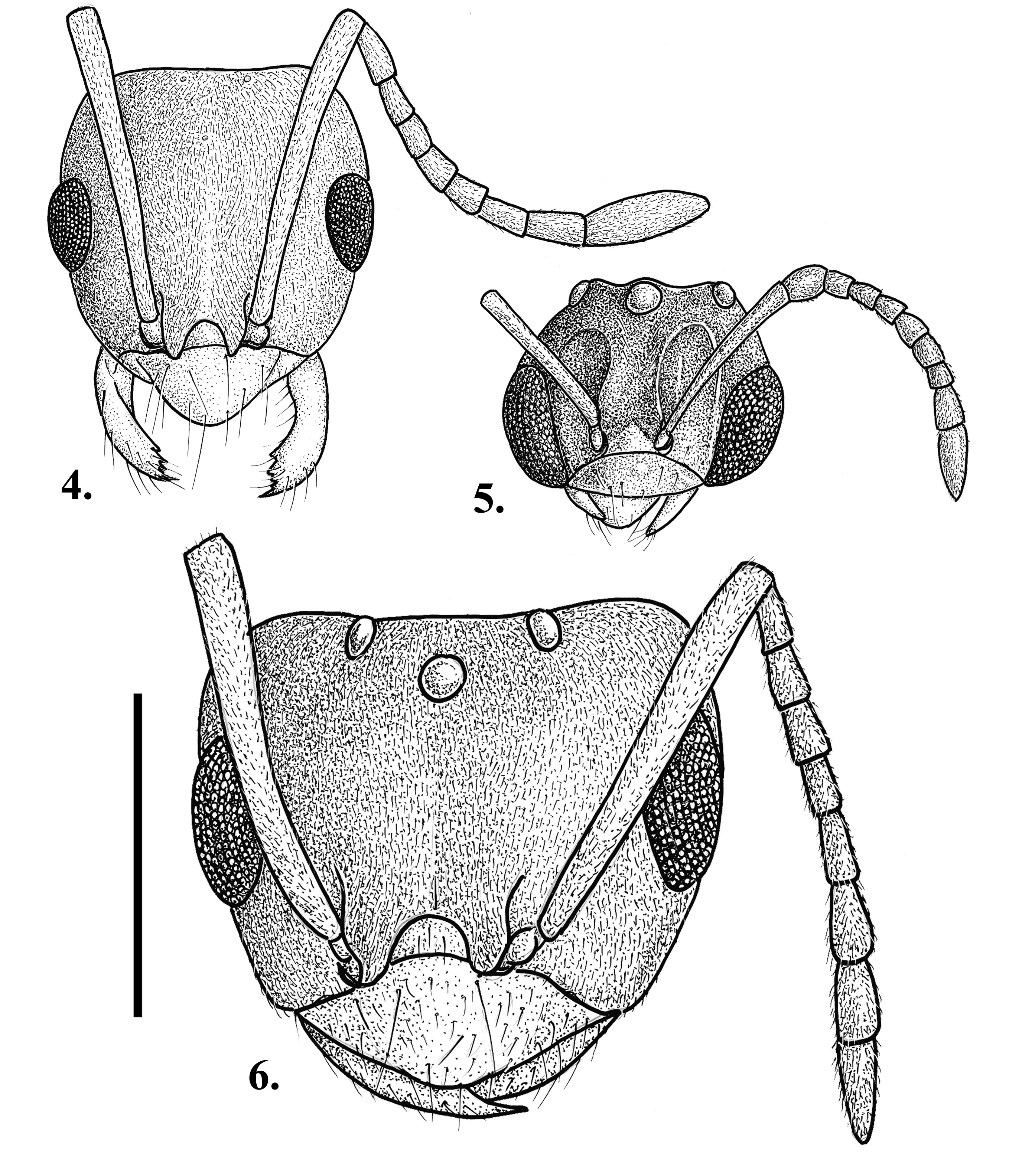
Introduction Brachymyrmex species can be identified by their one-segmented petiole, the presence of an acidopore, and their nine-segmented antennae. Brachymyrmex patagonicus Mayr (Formicinae), the dark rover ant, is a minute dark brown species with pale tarsi and mandibles and brownish-yellow antennae. The promesonotum usually has at least four erect hairs. The gaster has sparse, but rather long pubescence. The head is slightly wider than long. The eyes are relatively large; about as long as the length of the malar space. Minute ocelli are lacking, but some large setal sockets may give the impression of ocelli. The scape obviously surpasses the occipital border. This native to the Argentina and Paraguay has become widespread in the southeastern US and has expanded its range into isolated locations in the Southwest and California. A word of caution, this group is in need of revision. This particular species has been identified as both B. musculus Forel and B. patagonicus for the last 30 years since it was first reported to occur in the United States in 1978 (Wheeler and Wheeler 1978). Note that this species has actually been in the US since at least the 1950's based on material collected by E.O. Wilson from Mobile, AL (Pers. Comm. Chris Wilson). Brachymyrmex patagonicus, which is the type species, was redescribed by Quiran et al. (2004). A recent publication by MacGown et al (2007) and a poster by MacGown and Hill (2007) presented the known distribution of this species (which appears to be rapidly expanding) in the U.S., figures of all castes, biological and pest status, and brief diagnoses of all castes. Based on a recent worldwide molecular and morphological treatment of Brachymyrmex by Ortiz-Sepulveda et al. (2019), a possibility has been raised that specimens identified as B. patagonicus in the UShave been going under the wrong name. Ortiz-Sepulveda et al. (2019) examined very little material from the southeastern United States, though they included isolated records of B. bruchi from Florida, Louisiana, and Texas. No mention of B. patagonicus being found in the US was made. We ran representative specimens from Mississippi previously identified as B. patagonicus through their key, but were unable to conclusively determine our species based on the provided couplets with the closest matches being B. bruchi Forel, B. oculatus Santschi, and B. patagonicus. Based on large eye size alone, we keyed MS specimens to B. oculatus, but our specimens appear to have at least a medial ocellus, lacking in B.oculatus. Likewise, in the couplet separating B. bruchi and B. patagonicus, the US specimens we examined appeared to have characteristics of both species (scapes shorter as in B. patagonicus and often more than two erect pronotal setae as in B. bruchi. Due to this confusion, we are sticking to the currently widely used name of B. patagonicus at this time. Taxonomic History (provided by Barry Bolton, 2015) Diagnosis Identification Queen. About three times larger than worker: TL ≈ 4.0mm. HL 0.74-0.75mm, HW 0.73-0.76mm, SL 0.62-0.67, EL 0.27-0.30, MeSL 1.24-1.42mm (n=15) (MEM specimens). Concolorous light brown. Head about as wide as long, with abundant, fine pubescence, and with long erect setae present; large compound eyes located at middle of side of head; three large ocelli present; frontal lobes well developed; scapes surpassing occipital border by 1/4 their length. Mesosoma with moderately dense, fine pubescence, and 30-40 long erect setae (about 3-4 times length of fine pubescence); anepisternum and katepisternum separated by a distinct suture, with erect hairs present. Forewing with pterostigma; hind wing with 7 hammuli. Waist is one-segmented; node of the pedicel with an almost flat anterior edge and often obscured by the overhanging gaster. Gaster with moderately dense, fine pubescence, and erect hairs along apical edges of sternites and tergites; acidophore present. Male. About the same size as worker: TL ≈ 1.5 mm, HL 0.32-0.37mm, HW 0.32-0.37mm, SL 0.24-0.29, EL 0.17-0.20, MeSL 0.80-0.84mm (n=5) (MEM specimens). Head dark brown to blackish-brown, rest of body, including appendages, very light brown. Head about as wide as long, with fine, sparse pubescence, lacking erect setae except on mouth-parts, and with smooth, shiny integument; frontal lobes reduced; distinct longitudinal depression starting at the antennal insertion point and continuing posteriorly to just before the ocelli; eyes large, at least 1/2 the length of the head; three large, raised ocelli present; antennae 10-segmented with the first funicular segment enlarged, almost globular, wider than succeeding segments; scapes surpassing occipital border by more than 1/5 their length. Mesosoma with sparse pubescence and shiny integument, lacking erect setae. Hind wing with 5 or 6 hammuli. Waist is one-segmented; pedicel with small pointed node. Gaster shiny, lacking pubescence, with scattered erect setae on last few sternites and tergites. Biology and Economic Importance Pest Status Distribution Nearctic: United States (antweb.org, antwiki.org and MEM). U.S. Distribution: AL, AR, AZ, CA, FL, GA, LA, MS, NC, NM, NV, SC,TN, TX (antweb.org, Keefer 2016, and MEM). Acknowledgments Literature Cited Bolton, B. 2015. An online catalog of the ants of the world. Online at: http://antcat.org. Accessed 1 December 2015. Dash, S.T., L. M. Hooper-Bui, and M. A. Seymour. 2005. The pest ants of Louisiana. A guide to their identification, biology, and control. Louisiana State University, Louisiana Agricultural Experiment Station, Louisiana Cooperative Extension Service, Pub. 2915. Keefer, C. T. 2016. Biology, diet preferences and control of the dark rover ant, Brachymyrmex patagonicus (Hymenoptera: Formicidae), in Texas. Ph.D. Dissertation, Texas A&M University, College Station, TX. 114 pp. MacGown, J. A., J.G. Hill, and M. A. Deyrup. 2007. Brachymyrmex patagonicus (Hymenoptera: Formicidae), an emerging pest species in the southeastern United States. Florida Entomologist 90: 457-464. [pdf] MacGown, J. A. and J. G. Hill. 2007. Brachymyrmex patagonicus (Hymenoptera: Formicidae), an emerging pest species introduced into the southeastern United States. Mississippi Entomological Society 24-26 Oct. 2007. [power point poster] Mayr, G. 1868. Formicidae novae Americanae collectae a Prof. P. de Strobel. Annuario della Società dei Naturalisti e Matematici, Modena 3: 161-178. Ortiz-Sepulveda CM, Bocxlaer BV, Meneses AD, Fernández F (2019) Molecular morphological recognition of species boundaries in the neglected ant genus Brachymyrmex (Hymenoptera: Formicidae): toward a taxonomic revision. Quiran, E. M., J. J. Martinez, and A. O. Bachmann. 2004. The Neotropical genus Brachymyrmex Mayr, 1868 (Hymenoptera: Formicidae) in Argentina. Redescription of the type species, B. patagonicus Mayr, 1868; B. bruchi Forel, 1912; and B. oculatus santschi, 1919. Acta Zoologica Mexicana 20: 273-285. Wheeler, G. C. and J. Wheeler. 1978. Brachymyrmex musculus, a new ant in the United States. Entomological News 89: 189-190. Wild, A. 2008. Myrmecos Blog: Rover Ants (Brachymyrmex patagonicus), an emerging pest species. http://myrmecos.wordpress.com/2008/05/27/rover-ants-brachymyrmex-patagonicus-an-emerging-pest-species/ (accessed 5 June 2008). Links and Fact Sheets AntWeb Layton, B. and J. A. MacGown. 2008. Rover Ants: Mississippi Extension Pest Control Sheet. [pdf] Myrmecos Blog: Rover Ants (Brachymyrmex patagonicus), an emerging pest species. http://myrmecos.wordpress.com/2008/05/27/rover-ants-brachymyrmex-patagonicus-an-emerging-pest-species/ |
||



MEM | Research Taxa | Introduction | Faunal Lists | Identification | How to Use the Keys | Glossary | Collecting Tips | Specimen Preparation MEM Publications | MEM Ant Publications | Ant Videos | Ant News | MEM Ant Blog | References | Acknowledgments | Links
Author-Joe MacGown: jmacgown@entomology.msstate.edu
The ant web site was uploaded on 6 March 2003 and was last updated on 7 February 2022
(specific pages may have different uploaded and updated dates)
Drawings and photographs by Joe MacGown (unless otherwise noted) and copyrighted by the Mississippi Entomological Museum
The development of this web site was supported in part by the National Institute of Food and Agriculture, United States Department of Agriculture, under Project No. MIS-012040 and the USDA-ARS Areawide Management of Imported Fire Ant Project (Richard L. Brown, Principal Investigator).