

Antheraea assamensis (Helfer)
Muga Silk
Muga silk is almost exclusively produced in Assam in northeastern India, where it has been cultivated for many centuries. The muga silkmoth is Antheraea assamensis (Helfer). The caterpillars feed on trees in the laurel family (Lauraceae) including ones in the genera Litsea, Machilus, Cinnamomum, and Actinodaphne. They also are known to use trees in other families, including some in the magnolia family, like Michelia. Lampe (2010, page 274) reared larvae in Germany on beech (Fagus sylvatica). The insect ranges in sub-Himalayan India, Nepal, Bhutan, Thailand, Burma, and southern China.
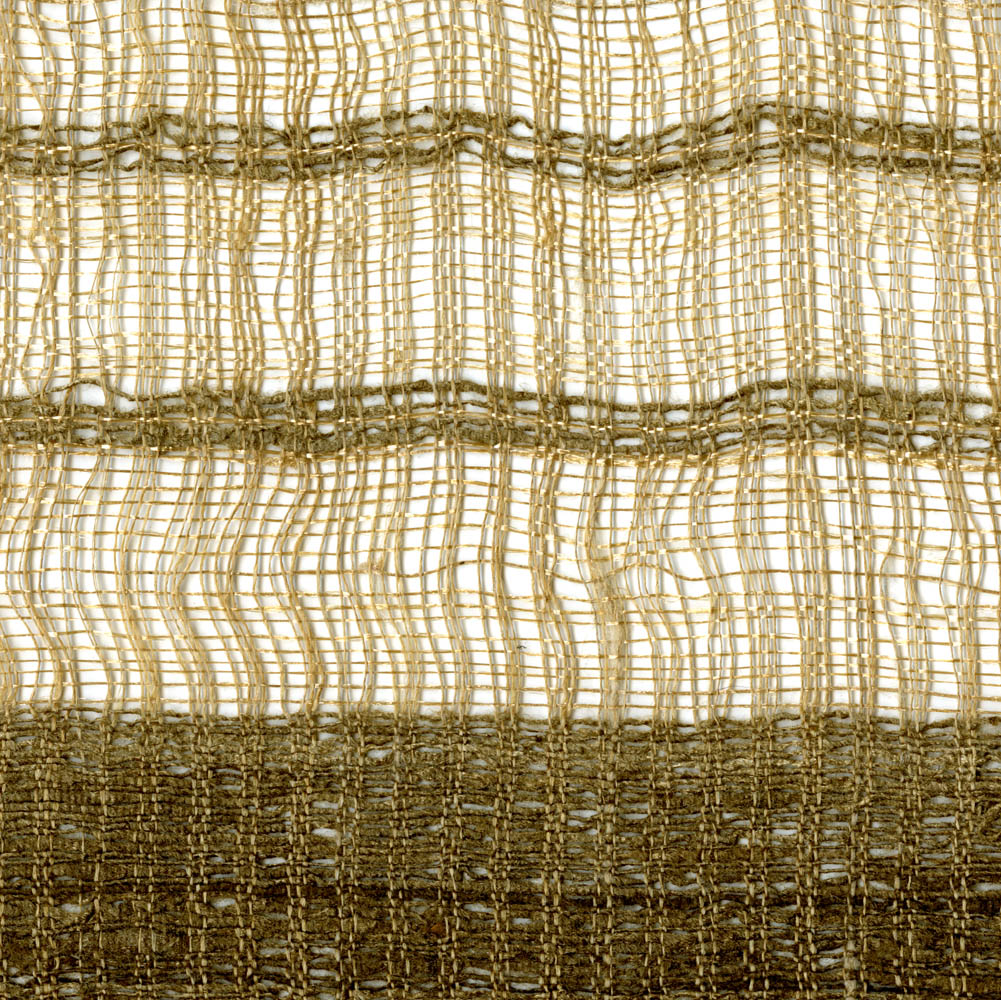
As our illustrations show, the silk is a beautiful golden color, and consequently it is almost never dyed. It has great cultural value in Assam and is highly regarded all over India. Saris made of muga silk are quite costly and are highly prized by their owners. Most of the muga weaving takes place in the Assamese village of Sualkuchi (Baishya 2005). We illustrate here a piece of fabric from there. Mekhela chaddars are worn by women on special occasions, and many of these are beautifully embroidered or brocaded in traditional colors (red, yellow, green) with traditional motifs, as can be seen on the choli (blouse) we show here. Some wrappers are also composed of spun silk, which has a golden brownish color, but not the brilliant gold color of the reeled cloth. The dhoti shown here is the most diaphanous wild silk textile we have seen. It would be worn only on very special occasions. Muga silk is little-known to westerners, but now has an emerging market in Japan.
Occasional articles about muga silk in magazines, such as those by McLaughlin (2009) and Balasubramaniam (2010), offer a lot of photographs and current information. An excellent reference on muga silk is a small book by Chowdhury (1981), and Phukan (2010) has since provided an extremely comprehensive and well-presented treatise on the industry. Although it contains no illustrations, Phukan’s book gives many details on sericulture, history, processing, marketing, and socio-economics of muga silk, as well as discussions about preserving this heritage industry and its future prospects.
Unfortunately, a lot of the textiles sold as muga are actually counterfeit. Reeled tussah, tasar, and mulberry silks maybe dyed or tinted a golden color, and the results look like muga but they do not have the same coarse feel that reeled muga fabrics possess (Phukan 2010, page 119). However, items marketed as muga by the Italian firm Anichini are genuine muga.
Description: Fabric of muga silk (Antheraea assamensis) handwoven in Sualkuchi, Assam. The threads are reeled silk. Purchased in Guwahati, Assam, by textile authority Lenore Blackwood (Sydney, Australia) in January 2005. Production Location:Sualkuchi, Assam, India Measurement: |
 |
 |
Description: Man's ceremonial waistcloth, called a dhoti, of muga silk (Antheraea assamensis) from Sonidan, Meghalaya, Composed primarily of reeled silk from the outer portions of cocoons. The dark bands are spun silk from the inner portions of the cocoons. All threads are natural colored in the whole piece. Received directly from India, 2009. Production Location: Sonidan, Meghalaya, India Measurement: 50cm x 204cm |
 |
 |
Description: A choli (woman's blouse) composed of reeled muga silk (Antheraea assamensis) from Assam, India. Probably hand-loomed. It is new and unstitched. Color patterns made by discontinuous weft brocading. Received 2009 by mail order. Production Location: Assam, India Measurement: |
References
Baishya, P. 2005. The silk industry of Assam: a case study of the Sualkuchi cluster. Spectrum
Publications, Guwahati & Delhi. 140 pp.
Balasubramaniam, C. 2010. Golden silk: the pride of Assam - literally the queen of silks.
British Patchwork & Quilting, Issue 192: 60–63.
Chowdhury, S. N. 1981. Muga silk industry. Directorate of Sericulture & Weaving, Gauhati,
Assam. v + 178 pp.,+ 46 figures.
Lampe, R. E. J. 2010. Saturniidae of the world...Pfauenspinner der Welt: their life stages from
the eggs to the adults...ihre Entwicklungsstadien vom Ei zum Falter. Verlag Dr. Friedrich
Pfeil, München. 368 pp.
McLaughlin, T. 2009. Dying for gold. Wild Fibers 6(3): 40–53.
Phukan, R. 2010. Muga silk: problems and prospects of muga silk industry of Assam, India.
VDM Verlag Dr. Müller, GmbH, Saarbrücken. 146 pp.
Phukan, R. & S. N. Chowdhury. 2006. Traditional knowledge and practices involved in muga
culture of Assam. Indian Journal of Traditional Knowledge 5(4): 450–453.
Saikia, S. 2012. Muga silk: the golden silk of Assam. Lambert Academic Publishing,
Saarbrücken. 78 pp.
